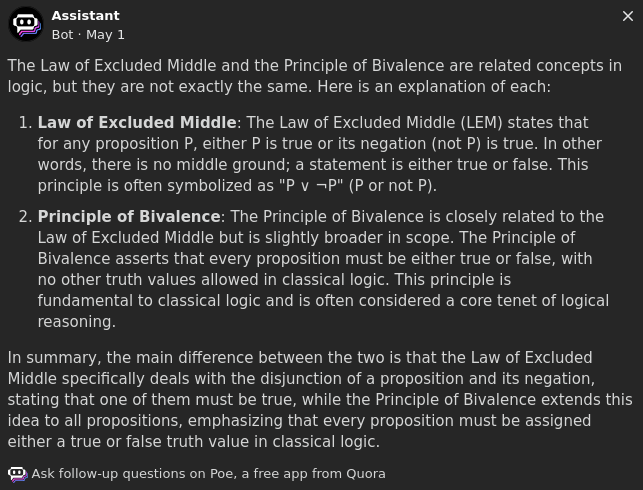
 The image to the right gives an example of two laws, or two principles. The "Law of Excluded Middle" and the "Principle of Bivalence." They are presented as being distinct from each other, but in fact, they are two sides of the same hair being split down the middle, and they're simply talking about the same underlying logical structure from two angles, one more general than the other.
Often the distinction between a concretization and its generalization is obvious, but in this case, people actually debate the difference between these two a lot, comparing them as if they are working on the same level. I found this when I tried to understand the difference between the two. I decided people are falling into a fallacy which is structurally similar to the fallacy of bifurcation:
A person commits the fallacy of bifurcation when he or she claims that there are only two mutually exclusive possibilities—when, in fact, there is a third option. For this reason the fallacy is also known as the either-or fallacy and the false dilemma. -- AnswerGenesis
However, I said similar because it's not exactly a fallacy of bifurcation. You'll note there is no third thing being presented between these two examples, so what do I mean?
I mean something I couldn't find when I went searching for it, and I realized there is something missing from the list of fallacies out there -- fallacies whose description is designed to help undo the fallacy, not just label it.
Therefore, I'm inventing a new fallacy I call "hasty bifurcation" which addresses the difference between two "different" things by making the "third" option of bifurcation unite the two bifurcated things (instead of dividing matters even further with a third thing). It works like this:
"You're making a hasty bifurcation between LEM and PoB. In fact, they're actually talking about the same thing, which is simply a way of forcing things into a polarized relationship using logic. One is technically more general than the other, but both can be used interchangeably in almost all cases. So let's get back to the larger discussion."
The word "hasty" is there to remind people to look deeper. It brings to the surface the fact that someone is arguing about superficial differences between things which are substantially the same as if they are substantial differences. Slow down, look deeper, and the underlying unity comes into focus. The hasty bifurcation fades. When this card is played correctly, hasty bifurcation is a self-healing fallacy.
With a little research, it appears this new fallacy is composed of fragments of these 3 fallacies:
- https://en.wikipedia.org/wiki/Fallacy_of_accent
- https://en.wikipedia.org/wiki/Affirming_a_disjunct
- https://en.wikipedia.org/wiki/False_precision
More fallacies should come with hints and instructions on how to untangle them and get to the real substance of things. I do not propose to use this new fallacy to get out of situations where bifurcation is essential to the larger point being made, but only situations where people are splitting hairs instead of talking about deeper things.
With my proposed new fallacy comes a caveat: it is incomplete to summarize this fallacy (for example in a list of fallacies) without mentioning the self-healing component of it. You can word it any way you want, but keep the self-healing aspect of it, please, since it moves us away from name-calling toward solution-seeking. Call it something like self-healing hasty bifurcation. Or unifiable hasty bifurcation. Anything to prevent the irony of people arguing about the difference between LEM and PoB as if they were substantially different from each other.
Open to suggestion on my proposal. Thanks for listening.