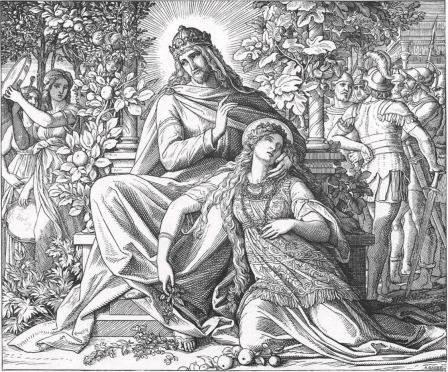
I've tried to read the Song of Songs a number of times, and never was able to penetrate into what's happening. Then one day a few months back, I was researching some other subject, and stumbled upon a book published in 1857 which attracted my attention. It advocates the "three character interpretation" of Solomon's Song instead of what I had been able to see, which was a poetically overwrought love story between two characters.
Intrigued, I soon came to the following passage from the Introduction which summarizes the story. I read it with great interest because it was the most coherent storyline I'd encountered:
The illustrator may not have realized she is saying "no" to him.
There was a family living at Shulem, consisting of a widowed mother, several sons, and one daughter, who maintained themselves by farming and pasturage. The brothers were particularly partial to their sister, and took her under their special care, promising that her prudence and virtue should be greatly rewarded by them. In the course of time, while tending the flock, and, according to the custom of the shepherds, resorting at noon beneath a tree for shelter against the meridian sun, she met with a graceful shepherd youth, to whom she afterwards became espoused.
One morning, in the spring, this youth invited her to accompany him into the field; but the brothers, overhearing the invitation, and anxious for the reputation of their sister, in order to prevent their meeting, sent her to take care of the vineyards. The damsel, however, consoled her beloved and herself with the assurance that, though separated bodily, indissoluble ties subsisted between them, over which her brothers had no control. She requested him to meet her in the evening, and as he did not come, she feared that some accident had befallen him on the way, and went in search of him, and found him. The evening now was the only time in which they could enjoy each other’s company, as, during the day, the damsel was occupied in the vineyards.
On one occasion, when entering a garden, she accidentally came in the presence of King Solomon, who happened to be on a summer visit to that neighbourhood. Struck with the beauty of the damsel, the King conducted her into his royal tent, and there, assisted by his court-ladies, endeavoured with alluring flatteries and promises, to gain her affections; but without effect. Released from the King’s presence, the damsel soon sought an interview with her beloved shepherd.
The King, however, took her with him to his capital in great pomp, in the hope of dazzling her with his splendour; but neither did this prevail: for while even there, she told her beloved shepherd, who had followed her into the capital, and obtained an interview with her, that she was anxious to quit the gaudy scene for her own home. The shepherd, on hearing this, praised her constancy, and such a manifestation of their mutual attachment took place, that several of the court-ladies were greatly affected by it.
The King, still determined, if possible, to win her affections, watched for another favourable opportunity, and with flatteries and allurements, surpassing all that he had used before, tried to obtain his purpose. He promised to elevate her to the highest rank, and to raise her above all his concubines and queens, if she would comply with his wishes; but, faithful to her espousals, she refused all his overtures, on the plea that her affections were pledged to another. The King, convinced at last that he could not possibly prevail, was obliged to dismiss her; and the shepherdess, in company with her beloved shepherd, returned to her native place. On their way home, they visited the tree under which they had first met, and there renewed their vows of fidelity to each other. On her arrival in safety at her home, her brothers, according to their promise, rewarded her greatly for her virtuous conduct.
Immediately upon finishing this summary, it occurred to me that this is remarkably similar to some of the more important aspects of the storyline from The Princess Bride. Buttercup is the Shulamite, Prince Humperdinck is an evil version of King Solomon, and Wesley is the beloved, the farmboy who rescues her from the Prince's persuasions.
It is easy to defend the argument that The Princess Bride is embedded so deeply into our cultural awareness because it is, like the perfect kiss at the end of it, a perfect story. I long ago decided the trio of (1) the small genius who fails because of his ego, (2) the talented swordsman whose greatest failure turns into ultimate his victory, and (3) the dumb giant whose nobility of character transcends his obedience to anyone smarter than him as a loose allegory of the body, heart, and mind. But I never pursued that line of thinking very far, except to think "this is one of the reasons we love the story so much: it's a map for how to harmonize these three dimensions of ourselves." Now I see that I was yearning for deeper meaning in the story in order to understand why I, and just about everyone else, love the story so much.
But now I see even more. It's a retelling of an ancient story so potent it was included in the Bible -- quite like the Book of Job is -- to convey the narrative of someone who holds firm to the Lord's ways even while surviving cartoonishly exaggerated temptations to let go. Someone who walks the straight and narrow way, and is eventually rewarded for doing so.
Apparently the three-character interpretation is only one of many ways to interpret the Song of Songs, but I'm sticking with it because, as you should know by now, I love the number three, and this perspective is just too beautiful to let go of.